
 home
home sport betting
 live casino
 fishing game
 lottery
 Guide aq999
Poker combines card strength, betting decisions, table position, and incomplete information, making rule knowledge essential before real-money participation. Bangladeshi readers exploring AQ999 can use this guide to understand core mechanics without assuming any particular platform feature or payment option. The sections below explain rankings, betting rounds, positional considerations, major variants, and mathematical hand frequencies.
Fundamental concepts of casino and live poker
Understanding poker starts with separating universal card concepts from rules that change between variants and casino formats. Hand rankings establish comparative strength, while betting rounds determine when participants can check, bet, call, raise, or fold. Position and variant-specific structures then shape how those decisions are made during actual hands.
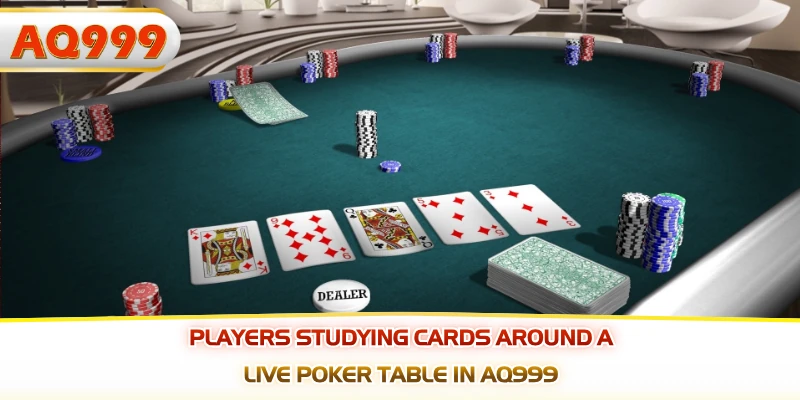
Learning poker hand rankings from high card to royal flush
Standard rankings begin with high card, followed by one pair, two pair, three of a kind, straight, flush, and full house. Above those combinations are four of a kind, straight flush, and the royal flush, which uses ten through ace in one suit. When two players hold the same category, card values and applicable kickers generally determine which qualifying five-card combination ranks higher.
A flush therefore defeats a straight regardless of how visually strong the straight appears, while a full house beats either combination. Memorizing this hierarchy helps users read showdowns efficiently without confusing a visually attractive holding with a mathematically stronger ranked hand.
Key betting rounds – Pre-Flop, Flop, Turn, and River
In Texas Hold’em, pre-flop action begins after each participant receives two private hole cards and mandatory blinds have been posted. The flop reveals three community cards, creating the first shared board and providing considerably more information about potential made hands and draws. A fourth community card, called the turn, follows another betting round and can substantially change available combinations or drawing possibilities.
The river supplies the fifth and final community card, after which remaining participants complete the last betting round before any necessary showdown. Betting order and available actions depend on position, previous action, stack sizes, and the particular rules governing the table being played.
Positional advantage at the poker table explained
Position describes when a participant acts relative to opponents, and acting later generally provides more information about decisions already made during that round. Early-position participants must often decide with fewer behavioural clues because several opponents may still call, raise, or fold behind them. Late position provides additional observed actions, allowing decisions to incorporate information unavailable to someone required to act earlier in the sequence.
The dealer-button position is especially important in community-card formats because it normally acts late after the flop under standard Hold’em procedures. Positional advantage does not guarantee winning cards, but understanding it improves decision context and prevents treating every seat as strategically identical.
Popular variants – Texas Hold’em vs. Omaha vs. Casino Hold’em
Different poker variants can share familiar rankings while changing hole-card quantities, betting structures, opponents, and rules for constructing the final hand. Readers should identify these distinctions before switching tables because experience with one format does not automatically transfer to another.
- Texas Hold’em: Each participant receives two private cards and shares five community cards, building the strongest qualifying five-card hand from available cards.
- Omaha: Participants commonly receive four hole cards and must use exactly two of them together with exactly three community cards at showdown.
- Casino Hold’em: This house-banked format pits the participant against the dealer rather than against multiple competing players around a conventional cash-game table.
- Decision structure: Player-versus-player formats involve opponent actions and changing stack dynamics, while house-banked versions use predetermined dealer qualification and settlement rules.
- Table rules: Betting limits, qualifying conditions, side wagers, and specific procedures can differ, so the displayed rules should be reviewed before staking money.
Poker hand strengths and expected win rates
Hand-category frequency provides mathematical context for understanding why some five-card combinations are rarer than others. For standard five-card hands drawn from a conventional 52-card deck, there are 2,598,960 possible combinations. The approximate frequencies below describe being dealt five cards directly and should not be interpreted as expected win rates for every game format.

| Poker hand category | Example combination | Odds of being dealt | Strength tier |
| Royal Flush | A-K-Q-J-10, same suit | 1 in 649,740 | Highest |
| Straight Flush | 9-8-7-6-5, same suit | About 1 in 72,193 | Very high |
| Four of a Kind | Four queens plus another card | About 1 in 4,165 | Very high |
| Full House | Three kings and two sevens | About 1 in 694 | High |
| Flush | 5 cards of the same suit without consecutive ranks | About 1 in 509 | Strong |
| Straight | 5 consecutive cards of different suits | About 1 in 255 | Medium |
| Three of a Kind | Three jacks plus two unmatched cards | About 1 in 47 | Medium |
| Two Pair | Two aces and two fives | About 1 in 21 | Moderate |
| One Pair | Two tens plus three unmatched cards | About 1 in 2.4 | Basic |
| High Card | No qualifying combination | About 1 in 2 | Lowest |
These frequencies explain rarity rather than guaranteeing how often a category will win against opponents. In poker, context matters because a theoretically strong category may still lose when another participant completes a higher-ranked combination.
Key considerations for bangladeshi poker enthusiasts
For Bangladeshi users, technical knowledge is only one part of a controlled real-money gaming session. Emotional discipline matters because rapid decisions after losses can encourage larger or poorly considered wagers. Transaction procedures deserve similar attention, particularly when no verified platform-specific payment information has been supplied.

Emotional control and avoiding “Tilt” during games
Tilt describes emotionally driven decision-making after frustrating results, unexpected losses, mistakes, or other events that disrupt a participant’s normal judgment. During poker sessions, signs may include chasing losses, increasing stakes impulsively, playing too many hands, or continuing beyond a planned limit. A practical response is to establish a fixed entertainment budget and session duration before play begins, rather than improvising after losing money.
Choosing platforms with smooth deposits and withdrawals
Payment convenience should be assessed through displayed transaction information rather than assumptions about which methods a platform supports in Bangladesh. Before funding poker play, users should review available currencies, stated limits, processing conditions, account-verification requirements, and any clearly disclosed transaction charges. Deposit availability should not be assumed to mean that withdrawals use the same channel, limits, processing procedure, or verification requirements.
Conclusion
Poker becomes easier to navigate when hand rankings, betting rounds, table position, variant rules, and mathematical frequencies are understood separately. Strong card knowledge does not eliminate uncertainty, and emotional control remains important when real money is involved. AQ999 is the supplied brand reference, while responsible participation still requires personal spending limits and careful review of the actual gaming environment.
