
 home
home sport betting
 live casino
 fishing game
 lottery
 Guide aq999
Craps is a two-dice casino game built around the come-out roll, point numbers, and several distinct categories of wagers. For Bangladeshi users exploring the game through AQ999, understanding the betting layout is more important than reacting to the fast pace of a live table. This guide explains the main phases, line wagers, Come options, proposition bets, mathematical odds, and practical considerations for mobile play.
Unlocking live craps – How the game works
A round follows a structured sequence even though the large betting layout can initially appear complicated. Learning the come-out roll and point phase first gives craps beginners a framework for understanding when different wagers become active.
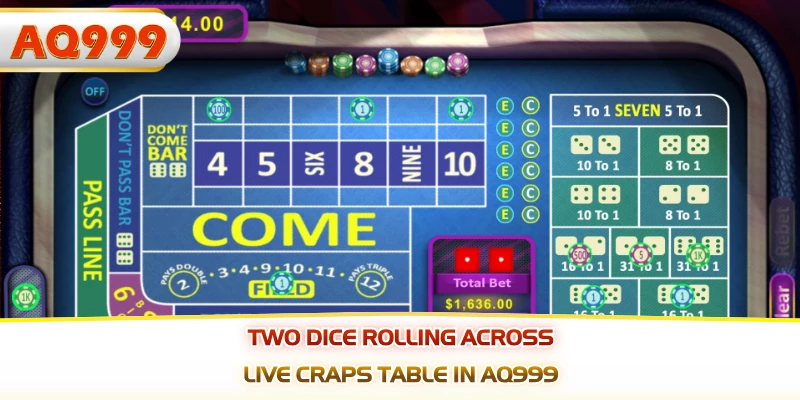
The come-out roll vs. The point phase – Basic game flow
The come-out roll begins a new craps round and determines whether the game resolves immediately or moves into the point phase. A seven or eleven wins a standard Pass Line wager immediately, while two, three, or twelve produces an immediate loss. If four, five, six, eight, nine, or ten appears, that number becomes the point and remains important until resolution.
During the point phase, the shooter aims to roll the established point again before rolling a seven for Pass Line purposes. Once either the point or seven appears, the line wager resolves and a new come-out sequence can subsequently begin.
Pass line and don’t pass line bets – The core options
The Pass Line is one of the most recognizable craps wagers because its result follows the main progression of each shooting sequence. On the come-out roll, seven or eleven wins Pass Line, while two, three, or twelve loses before any point becomes established. Don’t pass generally works in the opposite direction, although twelve commonly pushes rather than winning on the initial roll.
After establishing a point, Pass Line wins if that number returns before seven, whereas Don’t pass benefits when seven arrives first. These contrasting wagers have relatively small mathematical house advantages compared with many proposition bets, but neither can guarantee profitable results.
Come bets and don’t come bets – Extending your action
Come and Don’t Come wagers extend familiar line-bet mechanics into an active point phase, allowing additional numbers to become relevant during play. In craps, a Come wager begins with its own initial roll after placement and generally follows Pass Line-style resolution rules. If a point number appears, the Come wager moves to that number and waits for it or a seven to appear.
Don’t Come follows the opposing structure, with certain initial outcomes treated differently according to standard rules and the particular table configuration. Multiple active numbers can make the layout harder to follow, so beginners should understand settlement clearly before adding several simultaneous wagers.
Proposition bets and one-roll wagers explained
Proposition bets focus on particular dice outcomes and often resolve on the very next roll, creating faster decisions than line wagers. In craps, these choices can include individual totals or specific dice combinations, but payouts and availability vary by table. Their fast resolution can encourage frequent staking, so understanding both payout terms and mathematical disadvantage is essential before placing them.
- Any 7: This wager wins when the next two dice total seven, then resolves immediately regardless of the previous point or shooting sequence.
- Any craps: The wager covers a next-roll total of two, three, or twelve, combining several traditionally losing Pass Line come-out outcomes.
- Specific totals: One-roll bets may target totals such as two, three, eleven, or twelve, with payouts depending on the selected table rules.
- Hardways: These wagers involve selected even totals made with matching dice and normally remain active until their specific resolution conditions occur.
- Budget impact: Rapidly resolving propositions can generate repeated staking quickly, making a predetermined session budget particularly useful for controlling overall expenditure.
Bet types, odds, and house advantage breakdown
Mathematical comparison helps separate visually attractive payouts from wagers offering comparatively lower casino advantages. Standard probabilities can be calculated from the 36 equally likely ordered combinations produced by two fair six-sided dice, although table-specific payout rules still require checking.

| Bet name | Dice outcome needed | True odds | Payout | House advantage |
| Pass Line | 7/11 initially, or point before 7 | Rule sequence | 1:1 | 1.41% |
| Don’t Pass | 2/3 initially, or 7 before point; 12 pushes | Rule sequence | 1:1 | 1.36% |
| Any 7 | Total of 7 on next roll | 5:1 | 4:1 | 16.67% |
| Any Craps | Total of 2, 3, or 12 | 8:1 | 7:1 | 11.11% |
| 2 or 12 | Selected total on next roll | 35:1 | 30:1 | 13.89% |
| 3 or 11 | Selected total on next roll | 17:1 | 15:1 | 11.11% |
The comparison demonstrates why a large headline payout does not automatically indicate favourable mathematical value. Pass Line and Don’t Pass carry much smaller standard house advantages than several one-roll propositions, although short sessions can still produce highly variable outcomes. True odds also differ from casino payouts because the latter incorporate the mathematical advantage built into many wagers.
Winning strategies for playing game in Bangladesh
No betting method can reliably turn random dice outcomes into guaranteed income, so strategy is better understood as decision and budget management. These considerations help control exposure without suggesting that previous rolls can predict future results.

Choosing lower-edge wagers can reduce theoretical long-term mathematical disadvantage, although it cannot guarantee a positive result during any individual session. Standard Pass Line and Don’t Pass bets in craps carry lower house advantages than many proposition wagers shown in the comparison above.
A hypothetical BDT 1,000 entertainment budget can be divided into smaller session allocations instead of being treated as money requiring recovery. Consistent stake sizing may simplify expenditure tracking, but increasing or decreasing bets cannot change the independence of future dice combinations. Setting both monetary and time limits provides a clearer stopping framework when fast rolls might otherwise encourage unplanned additional wagering.
Conclusion
Craps becomes considerably easier to follow once the come-out roll, point phase, line bets, Come wagers, and proposition options are understood separately. Comparing house advantage alongside payout size also shows why seemingly attractive one-roll wagers can carry substantially different mathematical costs. AQ999 should be evaluated using the same verification, security, affordability, and responsible-gaming considerations applicable to any real-money online casino platform.
